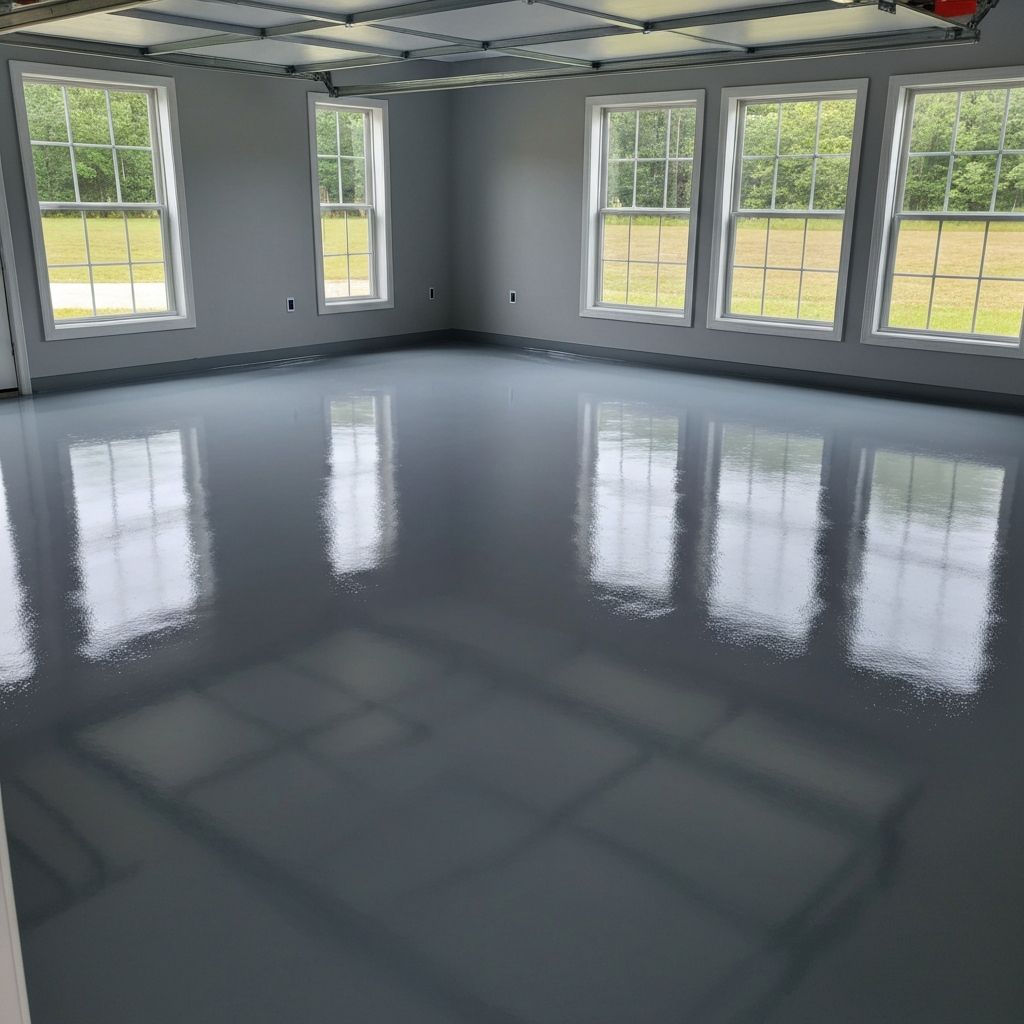
Best Garage Floor Coating for Savannah Humidity & Salt Air
A garage floor in Savannah deals with conditions that many coating guides never mention. Long, humid summers, damp mornings, coastal salt air, heavy rain and slabs that sit close to a high water table all affect how a coating bonds and how long it lasts. If you're planning to coat your garage, the best choice isn't simply "epoxy." It's a system chosen and installed for a humid, coastal climate.
Savannah Epoxy Floor connects you with local installers who coat garage, home and business floors across Savannah and the surrounding Lowcountry. We don't install floors ourselves. We match you with installers who do.
What a humid, coastal climate does to a garage floor
Moisture coming up through the slab
Concrete is porous. Moisture in the ground below a slab can move up through it as vapor. When a coating seals the top of the slab, that vapor can build up underneath and push the coating off, causing bubbles, blisters or peeling. That's why moisture testing matters so much here.
Humidity and condensation during install
High humidity changes how many coatings cure. Moisture in the air can settle on a cool slab as condensation, and some coatings react badly to that moisture, leaving a cloudy, hazy or tacky surface. Installers watch the dew point, the air temperature and the slab temperature, and schedule coats around them, rather than coating on a damp morning just because the crew is on site.
Salt air and corrosion
Near the coast, salt air settles on cars, tools and floors. Salt residue tracked in on tires and shoes can be gritty and corrosive, and it can work into bare concrete. A sealed, non-porous coating makes salt residue easier to rinse away, but grit left on the surface still wears down the topcoat over time.
Rain, puddles and slick floors
Summer storms bring water in on tires and under the garage door. A smooth, glossy floor can get slippery when wet. Texture from a flake or quartz broadcast, or an anti-slip additive in the topcoat, gives better footing.
Older and historic homes
Many homes in and around Savannah's historic district and older neighborhoods have carriage houses, detached garages or older slabs that may have been patched, painted or sealed over the years. Old paint, sealers and oil stains all have to come off before a new coating can bond.
What a humidity-ready coating system looks like
There isn't one product that's "best" for every garage, but installers in humid, coastal climates commonly build a system in layers:
Moisture testing first. Common methods include the calcium chloride test and in-slab relative humidity (RH) probes. The results help the installer decide whether the slab needs a moisture-mitigating primer.
Diamond-ground prep. Grinding removes the weak top layer, old paint and sealers, and opens the concrete so the coating can bond into it. Acid etching alone usually gives a weaker bond, and a weak bond is more likely to fail when moisture pushes from below.
Crack and joint repair. Cracks are filled and ground flush before coating so they don't show through or become a weak point.
A moisture-mitigating epoxy primer, when testing calls for it. These primers are made to reduce vapor coming through the slab. Ask your installer what moisture level their primer is rated for.
A 100% solids epoxy or polyaspartic base coat. 100% solids epoxy builds a thick, strong base. Some installers use a polyaspartic base for faster turnaround.
Decorative flake or quartz broadcast. This adds texture for wet-weather grip and helps hide dirt and small scuffs.
A UV-stable topcoat. Polyaspartic or polyurethane topcoats resist sun, abrasion and hot tires better than epoxy alone.
You can see the systems installers offer on our garage floor epoxy coating page.
Choosing a finish for a Savannah garage
Flake is the most popular garage finish. It hides tracked-in sand and dirt and adds grip on rainy days.
Quartz gives a textured, durable surface, often chosen for workshops and floors that get wet often.
Metallic epoxy has a high-gloss, marbled look, but it can be slick when wet and shows scratches more easily. If you want metallic, ask about anti-slip additives and a UV-stable topcoat.
Keeping a coated floor in good shape near the coast
Rinse or mop salt and sand often. Removing grit is the best way to protect the topcoat.
Squeegee standing water after storms instead of letting it sit.
Ask your installer which cleaners to use. Harsh cleaners can dull some finishes.
Give a new floor its full cure time before parking on it. In humid weather, cure can be slower, so follow your installer's timing.
Watch for bubbles or lifting and call your installer early.
Beyond the garage
Moisture is a bigger concern in floors that sit below or at grade. Learn more on our basement epoxy floor coating page. Outdoor slabs face rain, sun and salt air every day, which is why decks use different systems than garages. See our pool deck coating page. For shops, restaurants and storefronts, see commercial epoxy floor coatings.
Questions to ask before you hire
Will you test the slab for moisture, and which test will you use?
If the moisture is high, will you use a moisture-mitigating primer?
Will you diamond grind the floor, or only acid etch it?
How will you repair cracks and control joints?
How do you handle humidity and dew point on install day?
Is the topcoat UV-stable, and can you add anti-slip texture?
When can I walk on the floor, and when can I park on it?
What does the warranty cover, and does it cover moisture-related failure?
Get matched with a local installer in Savannah
The best garage floor coating for Savannah humidity starts with moisture testing, diamond-ground prep, repaired cracks and a UV-stable, slip-resistant topcoat. Savannah Epoxy Floor connects you with local installers who can look at your slab, explain your options and give you a written quote. Get your free instant quote and tell us about your project.
FAQ
Why do garage floor coatings bubble or peel in Savannah?
The most common cause is moisture moving up through the slab, made worse by poor prep. Moisture testing, diamond grinding and, when needed, a moisture-mitigating primer help prevent it.
Can you coat a garage floor on a humid day?
Often, yes, but installers watch the dew point and slab temperature. If condensation can form on the slab, many will wait or adjust the products they use.
Is polyaspartic or epoxy better for a humid climate?
Each has strengths. Epoxy builds a thick base and some epoxy primers are made for moisture control. Polyaspartic is UV-stable and cures faster. Many garage systems use both.
